
Why Transcription Comes Before Dictation
Why Transcription Comes Before Dictation
Feb 03, 2026
Dictation, just the word alone, triggers all kinds of sensations in me. I went through both public school and Catholic private school, and dictation was a weekly ritual I never looked forward to. I’ll be honest: I was never very good at spelling. I was always hesitating, one l… or was it two?
It wasn’t until I decided, as an adult, to take matters into my own hands that things began to change. The turning point came when I started writing passages from the books I was reading. Through that slow, attentive copying, I began to notice patterns, and gradually my spelling improved.
Interestingly, this experience mirrors exactly what Charlotte Mason describes in Home Education (Volume 1).
In Home Education (Vol. 1, p. 238), Charlotte Mason makes a clear and thoughtful distinction between transcription and dictation, and she is very deliberate about the order in which they should be introduced.
She writes:
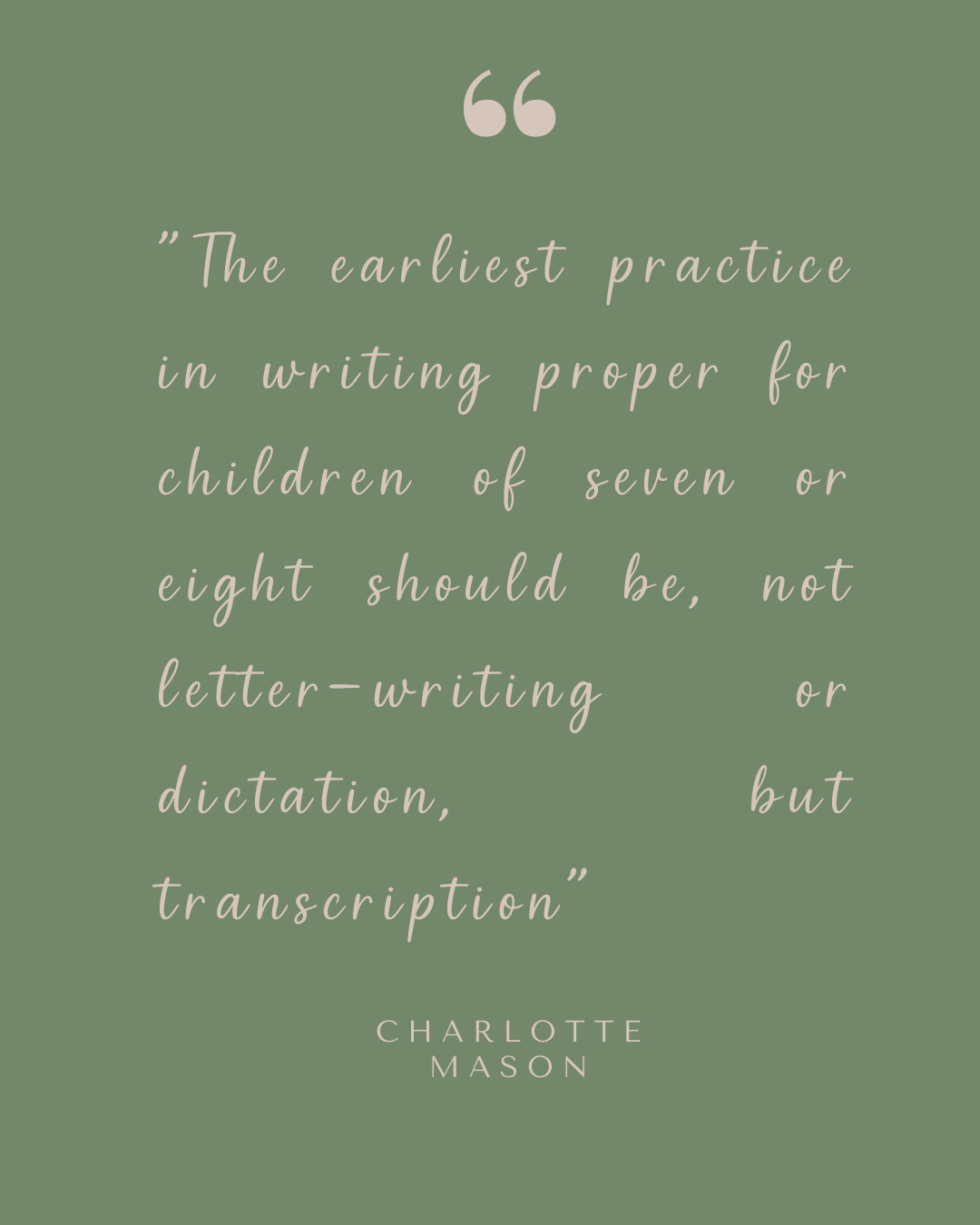
“The earliest practice in writing proper for children of seven or eight should be, not letter-writing or dictation, but transcription, slow and beautiful work…”
And again:
“Transcription should be an instruction to spelling. Children should be encouraged to look at the word, see a picture of it with their eyes shut, and then write [it] from memory.”
For many modern parents, especially those new to homeschooling, this order may seem counterintuitive. After all, if a child can spell words, why not simply dictate them?
Charlotte Mason’s answer is simple: dictation asks too much of a child who has not yet been prepared through transcription.
What Is Transcription?
Transcription is the practice of copying well-written text, slowly, carefully, and attentively. The child sees the word, processes it, and writes it exactly as it appears. There is no pressure to remember spelling or punctuation from memory. Instead, the focus is on forming habits of accuracy, attention, and visual memory.
Charlotte Mason viewed transcription as a form of training in which the eye, the hand, and the mind work together. It is not busywork. It is preparation.
The Rationale of Spelling
To understand why transcription matters so much, we must look at what Charlotte Mason believed about spelling itself.
In Home Education, Vol. 1, Chapter 12: Spelling and Dictation, p 240–242, she explains that spelling is primarily a matter of seeing words correctly, not sounding them out repeatedly:
“...the gift of spelling depends upon the power of the eye possesses to "take" (in a photographic sense) a detailed picture of a word; and this is a power and habit which must be cultivated in children from the first”
She goes on to emphasize the importance of visual impression:
“This picturing of words upon the retina appears to me to be the only royal road to spelling.”
And she makes clear that careless early work is harmful:
“an error once made and corrected leads to fearful doubt for the rest of one's life, as to which was the wrong way and which the right.”
Finally, she ties spelling instruction directly to carefully chosen texts:
“the teacher's business [is] to prevent false spelling, and, if an error has been made, hide it away, as it were, so that the impression may not become fixed.”
Transcription Builds the Right Habits
Charlotte Mason believed deeply in the power of habit formation. Transcription trains for:
- Careful observation
- Neatness
- Attention to detail
- Visual recognition of correct spelling.
When a child copies a passage, they are unconsciously absorbing correct spelling patterns and sentence structure. This is very different from memorizing spelling lists in isolation. Through transcription, spelling becomes natural rather than forced.
Charlotte Mason also encouraged children to choose their own transcription passages, giving them, as she wrote, “a certain sense of possession and delight.”
Why Dictation Comes Later
Dictation, by contrast, requires a child to:
- Hear a sentence
- Hold it in memory
- Recall correct spelling
- Apply punctuation
- Write it accurately.
This is a heavy cognitive load, especially for young children. Charlotte Mason warns that introducing dictation too early can lead to:
- Guessing at spelling
- Careless habits
- Discouragement
- Mental fatigue.
In Home Education, she explains that children should not be asked to spell words they have not already met, seen, and studied through transcription. Dictation should only include words that are already familiar to the child’s eye.
Why This Matters Today
In a modern educational climate that often rushes children into performance, Charlotte Mason’s approach feels refreshingly respectful. She reminds us that children need time to build clear mental pictures of words before being asked to reproduce them independently.
When transcription comes first:
- Confidence grows
- Errors decrease
- Spelling becomes meaningful
- Writing feels attainable.
This method honors the child’s development rather than pushing them ahead prematurely.
A Gentle Foundation for Literacy
Transcription before dictation is not about learning slowly; it is about laying a solid foundation. A child who has been patiently trained through transcription will approach dictation calmly, accurately, and with far less frustration.
As Charlotte Mason understood, strong literacy is not built through pressure, but through careful preparation, beautiful language, and steady habits.