
Latin Prefixes in English Spelling
Latin Prefixes in English Spelling
Apr 01, 2026
English spelling can seem irregular at first, but much of it becomes clearer when we understand where words come from. A large number of English words are built from Latin roots and prefixes, and these prefixes often shape both meaning and spelling in consistent ways.
Latin Prefixes in English Spelling
A prefix is added to the beginning of a word to change its meaning. You can refer to our post on How Words Are Built. In this post we introduced the notion of word morphology with the different prefixes and suffixes and how they impact the meaning of the word.
Many common prefixes come directly from Latin, such as:
- un- (not)
- re- (again)
- pre- (before)
- sub- (under)
- trans- (across)
- in- (not)
These prefixes appear in hundreds of English words and form recognizable patterns.
How Latin Prefixes Affect Spelling
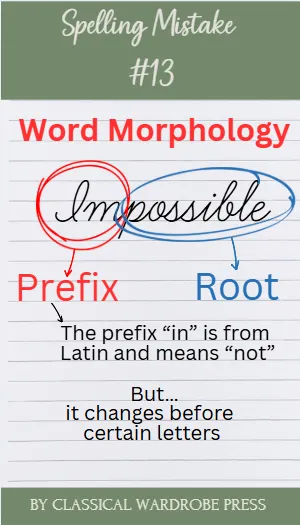
Latin prefixes do not always stay the same. They often change form to match the first letter of the base word, making pronunciation smoother.
This is one of the most important patterns to teach.
The Prefix in- (meaning “not”)
- in + possible → impossible
- in + legal → illegal
- in + regular → irregular
The prefix changes:
- in → im before p, b, m
- in → il before l
- in → ir before r
This is not random. It is a consistent spelling pattern based on sound.
To make this easier to remember, I’ve created a simple Downloadable Printable Guide you can use with your child.
Word Families Build Understanding
Teaching prefixes through word families helps children see structure clearly.
Example: sub- (meaning “under”)
- submarine
- submerge
- subsoil
- subtitle
The spelling of sub- remains stable, reinforcing both meaning and recognition.
Example: trans- (meaning “across”)
- transport
- transfer
- transform
- transmit
Children begin to recognize that trans- carries the idea of movement or change across something.
Why Children Make Mistakes
A child might write:
❌ inpossible
❌ unregular
These are not careless mistakes. They show that the child is:
✔ hearing the word correctly
✔ attempting to apply a prefix
What is missing is the knowledge that prefixes follow patterns of change.
Spelling Is More Than Sound
Phonics is essential, but it is only part of spelling. Latin prefixes show that spelling also depends on:
- meaning
- word structure
- history
When children understand this, spelling becomes more logical and less frustrating.
Simple Ways to Help Children Remember
Here are practical, gentle strategies:
1. Start with a root word
Begin with one familiar word and build from it.
For example:
regular → irregular → regulate → regularity
This helps the child stay anchored in meaning while seeing how words grow.
2. Explore prefixes through that root
Instead of teaching many prefixes at once, apply different prefixes to the same root word. Ask: What happens when we add a prefix? Does the meaning change?
This keeps learning focused and meaningful.
3. Notice correct forms and exceptions
Children may try forms like unregular, which shows understanding in progress.
By studying the correct word irregular, they begin to see that prefixes follow patterns of usage, not just simple rules.
4. Encourage careful observation
Ask: What do these words have in common? What part stays the same?
This helps children recognize the root within each word.
5. Use copywork in context
Let children copy well-written sentences containing these word families.
Through careful attention, the eye begins to remember the correct forms naturally.
Why Learning Latin Is Beneficial
Studying Latin, even at a simple level, can greatly support spelling.
Children begin to:
- recognise familiar word parts
- understand meanings more deeply
- spell longer words with confidence
Latin provides a foundation that makes English vocabulary more predictable and connected.
Here are some useful links to introduce Latin to kids:
- Storytelling in Latin on You Tube by Latin Storytime
- Latin through Stories Curriculum from Dallas University
- Memoria Press Latin program
A Language That Makes Sense
English spelling is not random, it reflects a long history shaped by Latin and other languages. When children understand prefixes, they gain a powerful tool. Words are no longer isolated or confusing, but part of a larger, meaningful system.
With time and practice, spelling becomes not a matter of guessing, but of understanding