
How Words Are Built: A Gentle Guide to Roots, Prefixes, and Suffixes
How Words Are Built: A Gentle Guide to Roots, Prefixes, and Suffixes
Mar 18, 2026
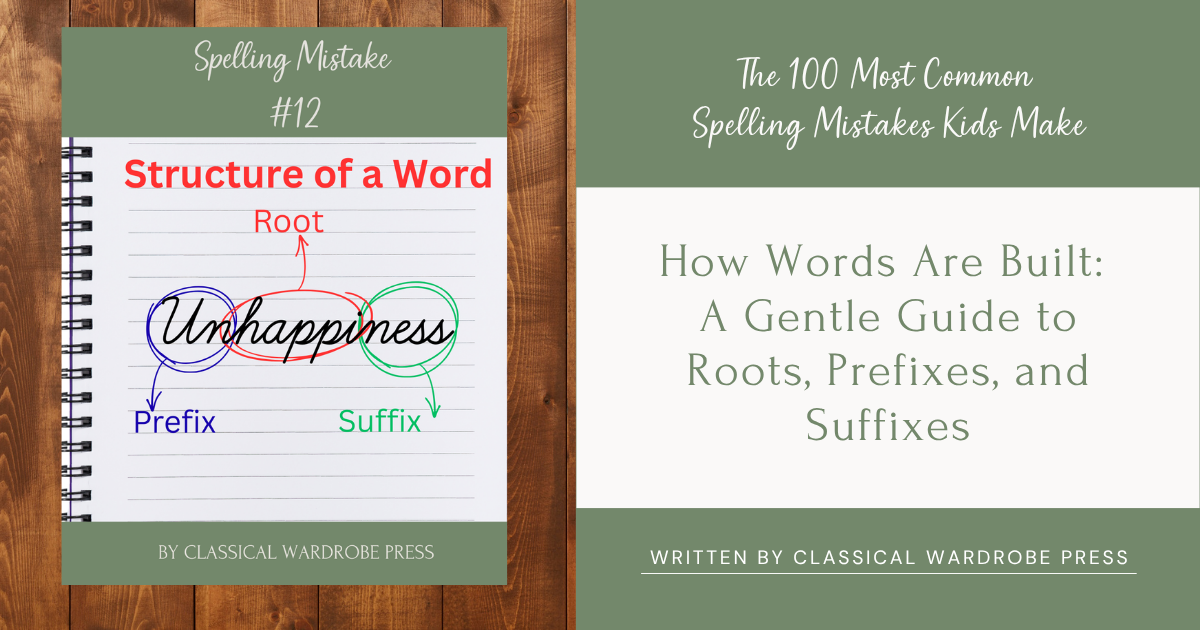
Understanding the structure of words is one of the most powerful tools a child can acquire for spelling, reading, and vocabulary development. Rather than seeing words as long strings of letters to memorise, children begin to recognise meaningful parts that fit together in predictable ways. Like building blocks, these parts help unlock thousands of words at once.
A Gentle Guide to Roots, Prefixes, and Suffixes
Most English words are made from three kinds of elements:
Root (or base word) — the core meaning
Prefix — added at the beginning
Suffix — added at the end
Not every word contains all three, but many do.
The Root: The Heart of the Word
The root (or base word) carries the central meaning. It can often stand alone as a complete word.
Examples:
- play
- help
- kind
- read
When children recognise the root, they can often infer the meaning of longer words built from it.
For instance: play → playful → replay → playing
Even as the word grows, the idea of “play” remains.
Prefixes: Changing Meaning at the Beginning
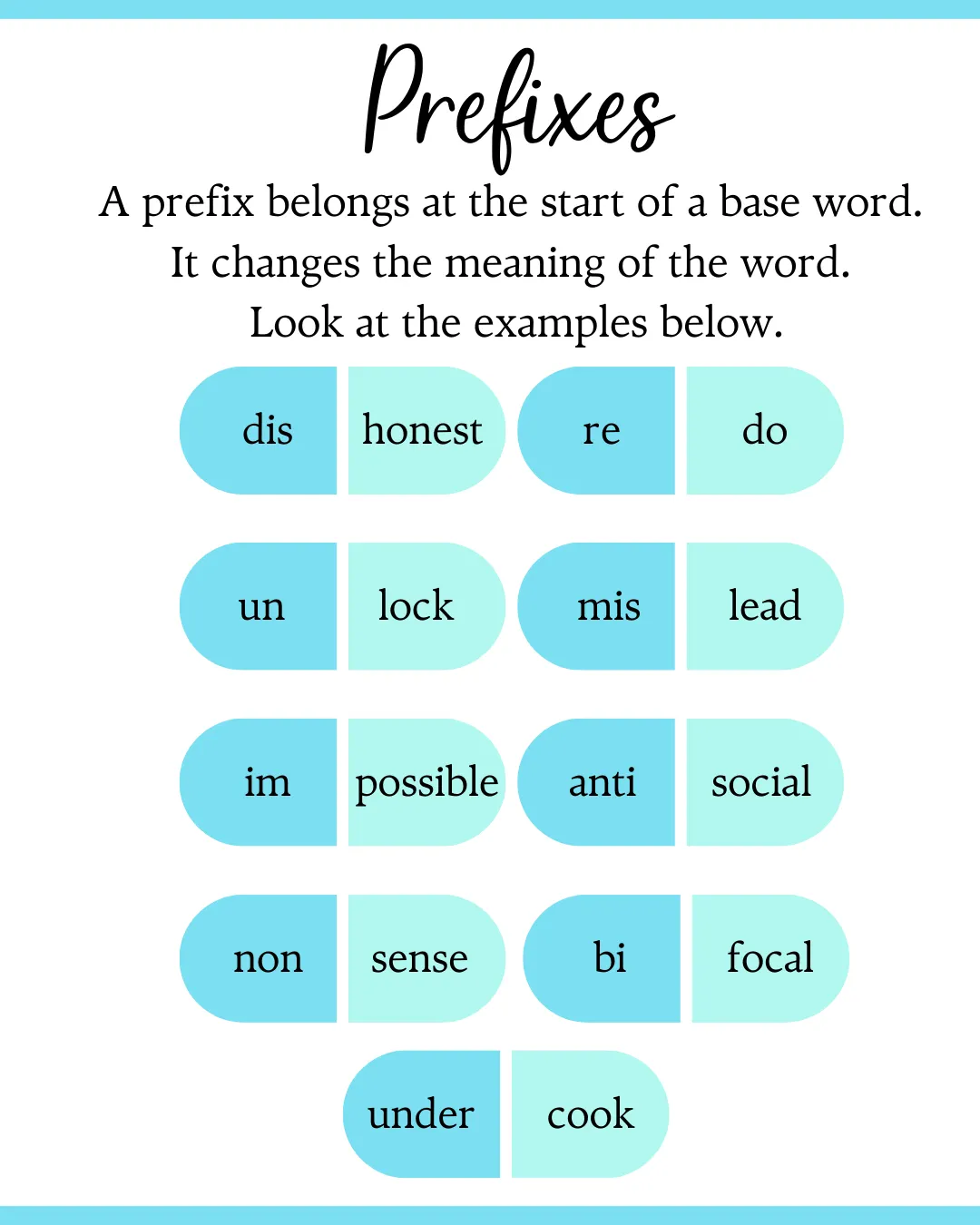
A prefix is added before the root and usually changes the meaning without altering the basic word class.
Common prefixes include:
- un- (not): unhappy
- re- (again): rewrite
- pre- (before): preview
- dis- (not or opposite): disagree
Consider the word: help → unhelpful
The root help is still visible, but the prefix changes the meaning to “not helpful.”
Recognising prefixes helps children decode unfamiliar words while reading.
Suffixes: Expanding Meaning at the End
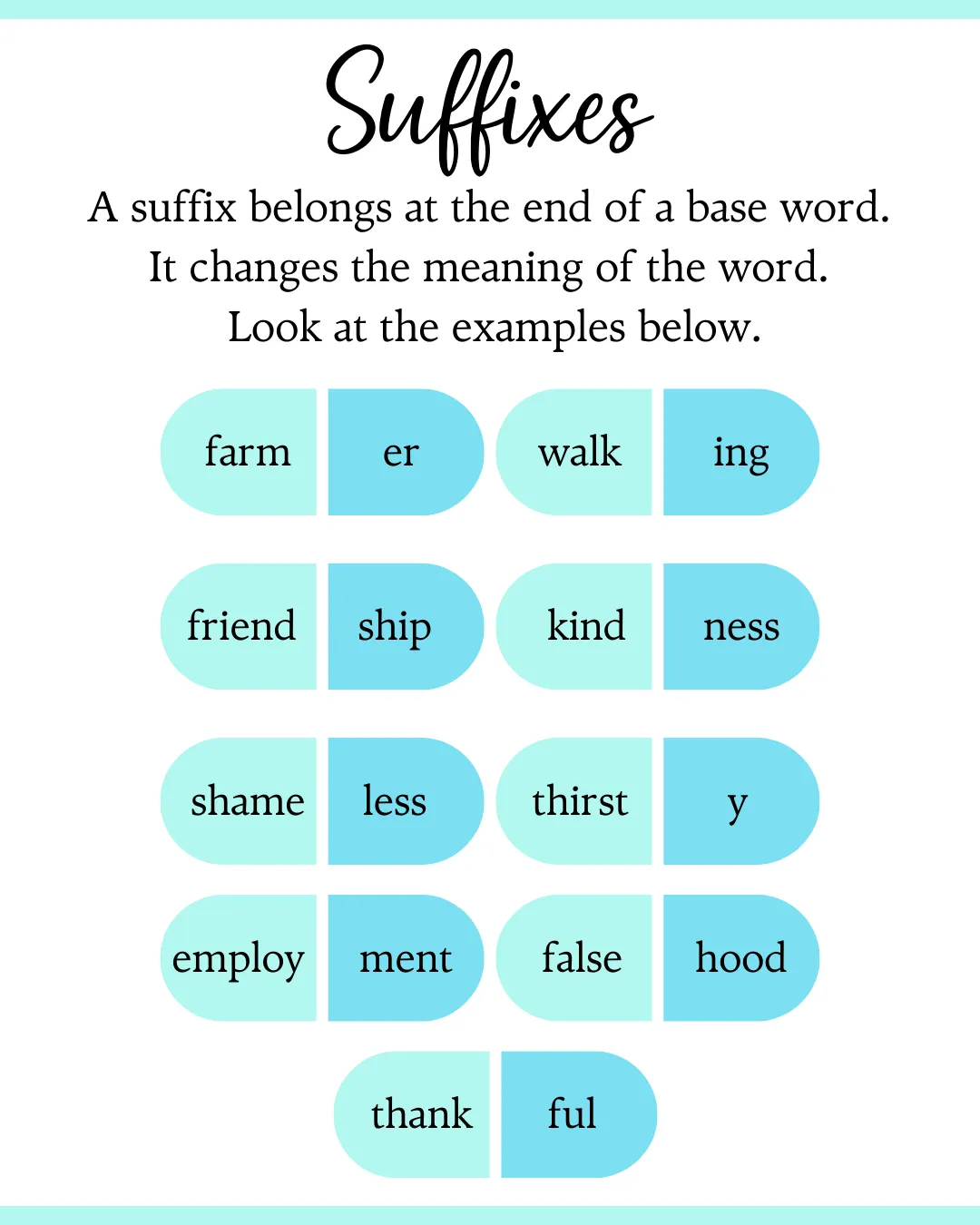
A suffix is added after the root. It may change meaning, grammatical function, or both.
Common suffixes include:
- -s / -es (plural): cats, boxes
- -ed (past tense): walked
- -ing (present participle): jumping
- -er (person who): teacher
- -ness (state or quality): kindness
- -ful (full of): joyful
Suffixes often signal how a word functions in a sentence.
For example: help → helpful → helpless → helplessness
Each addition builds a more specific meaning.
Words With Multiple Suffixes
English allows several suffixes to be stacked onto one root, forming long but logical words.
Example:
help
help + ful → helpful
help + ful + ly → helpfully
help + less → helpless
help + less + ness → helplessness
Although these words look complex, a child who recognises the parts can read and spell them with confidence.
Spelling Changes When Adding Suffixes
Sometimes the root changes slightly when a suffix is added. These changes follow patterns rather than random rules.
Examples:
- hope → hoping (The Magic "e" Rule)
- run → running (The 1-1-1 Rule)
- happy → happiness (The Consonant + Y Rule)
Understanding these patterns helps children avoid common spelling mistakes.
Why Word Structure Matters for Young Learners
Teaching word structure transforms spelling from memorisation into understanding.
Children learn that:
- Words are built from meaningful parts
- Patterns repeat across many words
- Longer words are not necessarily harder
- Reading and spelling support each other
Instead of seeing unhappiness as a daunting sequence of letters, a child can recognise: un + happy + ness
Three familiar pieces forming one new word.
Learning Through Observation and Practice
Educational approaches inspired by Charlotte Mason emphasise that children learn spelling best through meaningful language, careful observation, and steady practice rather than isolated drills.
When children encounter words in rich contexts, stories, poems, and well-written passages, they naturally begin to notice these recurring parts.
Over time, the structure of words becomes familiar, just as one recognises recurring patterns in music or design.
A Language Built Like a Puzzle
English vocabulary may seem vast, but much of it is constructed from a limited set of roots, prefixes, and suffixes. Once children understand this system, they gain a powerful key to decoding new words throughout their lives.
Spelling then becomes less a test of memory and more an act of recognition, seeing how the pieces fit together to form meaning.
In this way, learning word structure does more than improve spelling; it opens the door to confident reading, richer vocabulary, and a deeper appreciation of language itself.
Download our free Word Construction Exercises for practice.